Skips Collectables
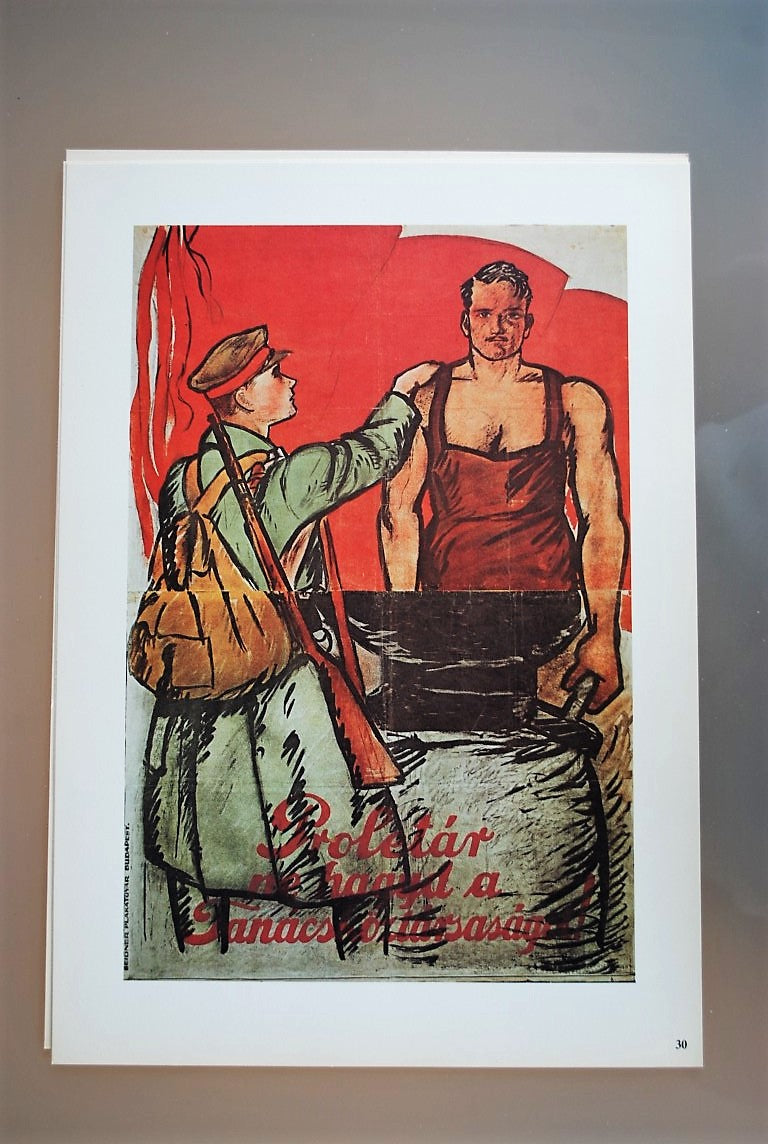
Posters of the Hungarian Soviet Republic 1919 - 1920
Posters of the Hungarian Soviet Republic 1919 - 1920
Couldn't load pickup availability
The Hungarian Soviet Republic - Progressive art and culture with social significance
During the very short period (133 days) of the Hungarian Soviet Republic, progressive and modern trends in art and literature became evident and dominated cultural policy. In fact, the modern and progressive Hungarian intelligentsia unanimously supported the new regime.
Although the Hungarian Soviet Republic was a failed experiment, adding to the already devastated suffering of Hungary, it was undoubtedly a unique endeavor that brought together young, immensely talented modernist minds and gave them a partial opportunity to shine. This modern utopia quickly revealed its enormous shortcomings, but its downfall was not without its traces. The most important influences of this era are the unique and daring propaganda posters, which were intended to convey their utopian ideas to the masses. Education, culture, and propaganda were intertwined, and each contributed to the great work of societal reform. Posters of the Hungarian Soviet Republic capture the spirit of this very short but significant period.
The Hungarian Soviet Republic was established peacefully and without bloodshed in the spring of 1919—unlike the Soviet Revolution of 1917, which led to civil war. This gave the new state strong legitimacy. Alongside the regime's socialist ideology, nationalist sentiments were also present, as the country was poised to continue the war to defend itself and its territorial integrity. This meant that the new regime could represent the key, despite the presence of differing opinions within Hungarian society.
Social issues had been a central concern for many Hungarian artistic groups since the 1910s. Some of them were avant-garde groups with a strong leftist ideology, similar not only to the Russian avant-garde but also to the Western avant-garde (such as Expressionist and Dadaist artistic groups). The question of social relevance was present in the work of the writers of the leading literary magazine Nyugat (West). Socialist ideology was dominant in the philosophy circle of Gyorgy (Georg) Lukacs, Vasárnapi Kör (Sunday Circle). Lajos Kassak published internationalist and left-wing articles in his magazines A Tett (Action) and Ma (Today). His circle described itself as Activist, referring to their efforts to bring about changes in the social system. In 1917, the news of the Soviet revolution unsettled all these groups.
Their terrible experiences during the First World War caused great disappointment and a strong desire for peace. The modern artist groups shared a desire for "a new system, a new world, new faith, and a new man." The conviction that a new world would emerge after this terrible war grew stronger and stronger. Their envisioned new world was defined by equality, which was to be achieved through the peaceful uprising of the lower classes. As the poet and writer Gyula Juhasz put it, "only the proletariat can create a new world, a better one, because it is true."
The Hungarian Soviet Republic seemed to meet the wishes of the artists, all of whom became prominent players in its cultural policymaking. The focus of the new cultural policy was on "removing the intellectual dominance of the bourgeoisie"—culture should not belong to them, but to everyone. To achieve this goal, the new regime had to restructure the system: from elementary schools to universities and museums. Education became free and schools became public. Art collections were expropriated; new libraries were opened across the country. The new system gave workers a real opportunity for education.
The modernist intelligentsia held important positions in the new system. Most played a central role in reforming cultural life. This meant that after the fall of the short-lived communist state, most of them had to leave Hungary to avoid retaliation and embark on new careers abroad—and we might add: this was a key factor in the fact that many of them later became world-famous.
All these great theorists and artists worked for an idealistic new world. They did not fail; they were able to maintain their original, modern way of thinking, and the dictatorship had no strong presence in the cultural sphere. According to Lukács's principles, there was no obligatory style, no "official" art (they were able to avoid the slavish acceptance of the Bolshevik idea of realism as the only acceptable style). Modernist tendencies were widely accepted and became a key component of the art and propaganda of the new system.
The theories of this leading group were evident in the propaganda posters, which were mainly created by the leading poster artists of the decade; Mihály Biro, Imre Foldes, Geza Farago, etc.; prominent avant-garde artists, such as Robert Bereny, Bela Uitz, Bertalan Por, Jozsef Nemes-Lamperth, Janos Kmetty, etc.) and other talented artists, most of whom later created a significant body of work, such as Marcell Vertes, Janos Tabor, Odon Danko, Jolan Szilagyi, etc.
All participating artists and theorists were in their twenties or early thirties. Mihaly Biro, one of the most important pioneers of propaganda poster design in the 20th century, created his most important works.
Posters of the Hungarian Soviet Republic capture the spirit of this very short but important period.
Posters were released in 1979, 60 years after the Hungarian Soviet Republic, and are A4 size.
24 x 34 cm printed on thick, sturdy paper.
Powerful texts, some of which I have translated;
Proletarian does not allow the council
With me or against me
In the Red Army
Don't hesitate to join the Red Army
Red newspaper
Working because the bread is running out
Republic
Age-related damage, scratches, dents, stains, etc.
COMPLETE MAP with all 32 posters and information booklet describing each poster.
ONLY FOR SALE AS A COMPLETE MAP!!
Each piece is ready to be framed.
€1.60 per poster. Set price €51.
Terms and conditions
Terms and conditions
- Shipping is once a week, usually on Wednesday, after payment has been received and is possible with the following shipping options.
- Insured shipping is preferred. Registered mail, letterbox package, or regular parcel shipping is also possible, but the buyer bears the risk.
Shipping costs for the advertisement are as a registered parcel up to 10 kg, please indicate if it needs to be insured.
Everything is packed to the best of our ability, but I have no control over clumsy behavior by shipping companies, and shipping is entirely at the buyer's risk.
If possible, we will try to ship as many items as possible in 1 package to keep shipping costs low.
- You can also reserve items that aren't yet available for sale, but only after a 10% deposit, with a minimum of €10. New items arrive in the Netherlands once or twice a year, so please keep in mind that reserving items can sometimes take months.
- The article descriptions are my own findings; I've done my best to find as much information as possible. No rights can be derived from this information. Please form your own opinion.
- Everything is old and used, so please take into account age-related wear, damage, scratches, dents, stains, etc.
Please view all photos carefully first, if you have any questions please ask before you buy.
Only purchase if you agree to the terms and conditions.